

Sharing Personal Data with Apps
Read more
When we download a messenger app, we often grant the provider access to our contacts – and with it, access to the personal data of other people. But how willing are we to share this kind of information, what concerns does it raise, and how responsible do we feel towards the people in our address book?
These were exactly the questions addressed in our latest Im Fokus survey from April 2026, conducted in cooperation with m.core/WU Vienna, on sharing personal data with apps. A total of 307 people took part in the study (52.1% female, 47.9% male; average age: 43.71 years, SD 13.48). To explore the topic, participants were asked to imagine downloading a fictitious messenger app called “ChatUp,” which requests access to their contacts.
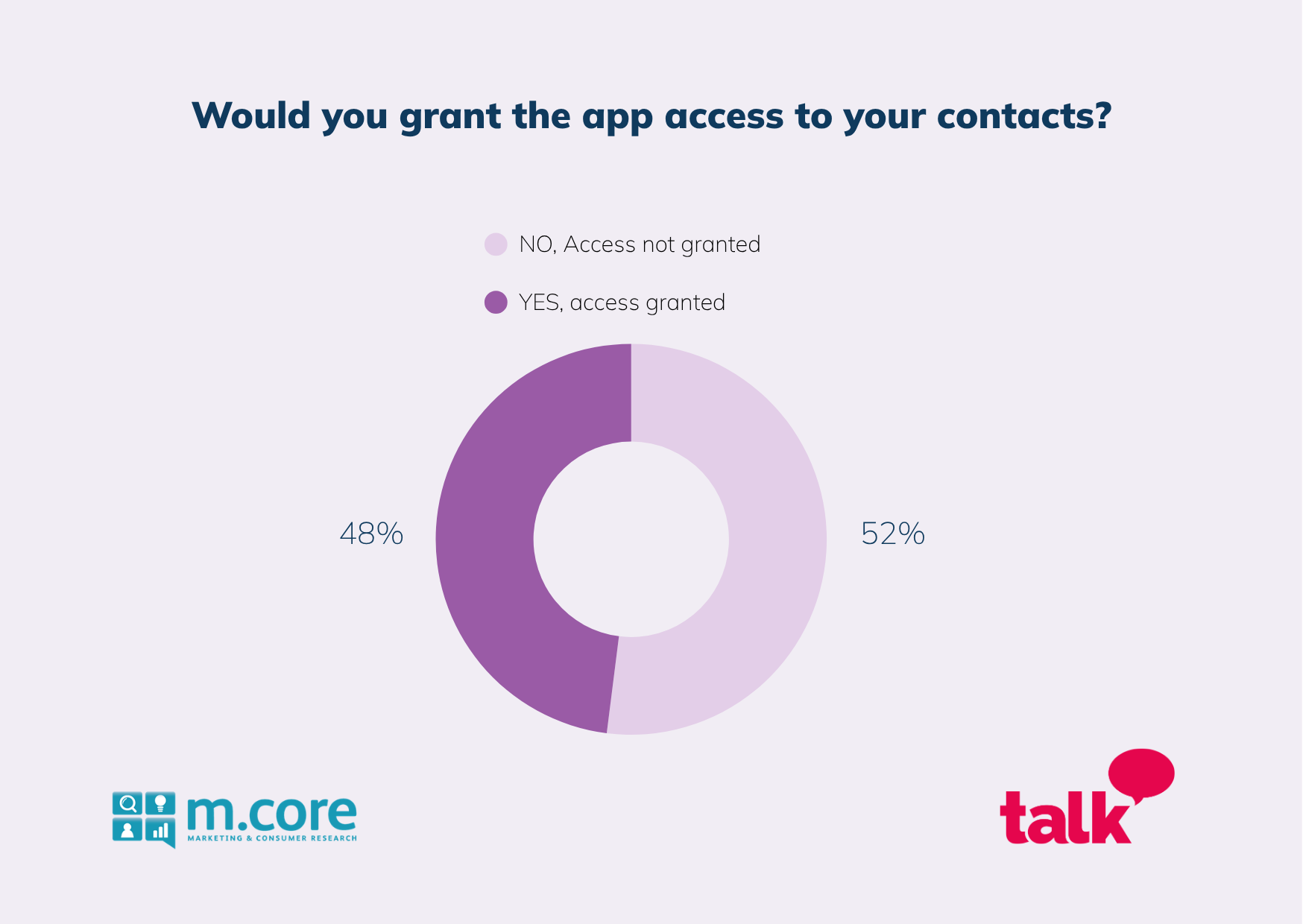
The results show a closely divided picture: 52% of respondents stated that they would not grant the app access to their contacts, while 48% would.
Age plays a role here as well. The older the respondents, the less willing they were to grant the fictitious messenger app access to their contacts (r = −.135, p = .018).
When asked what negative consequences granting access could have, participants most frequently mentioned spam and advertising, the passing on of data to third parties, and data theft. Other recurring concerns included fraud, spying, the misuse and sale of data, identity theft, breaches of privacy and data protection, and a loss of trust among their own contacts.
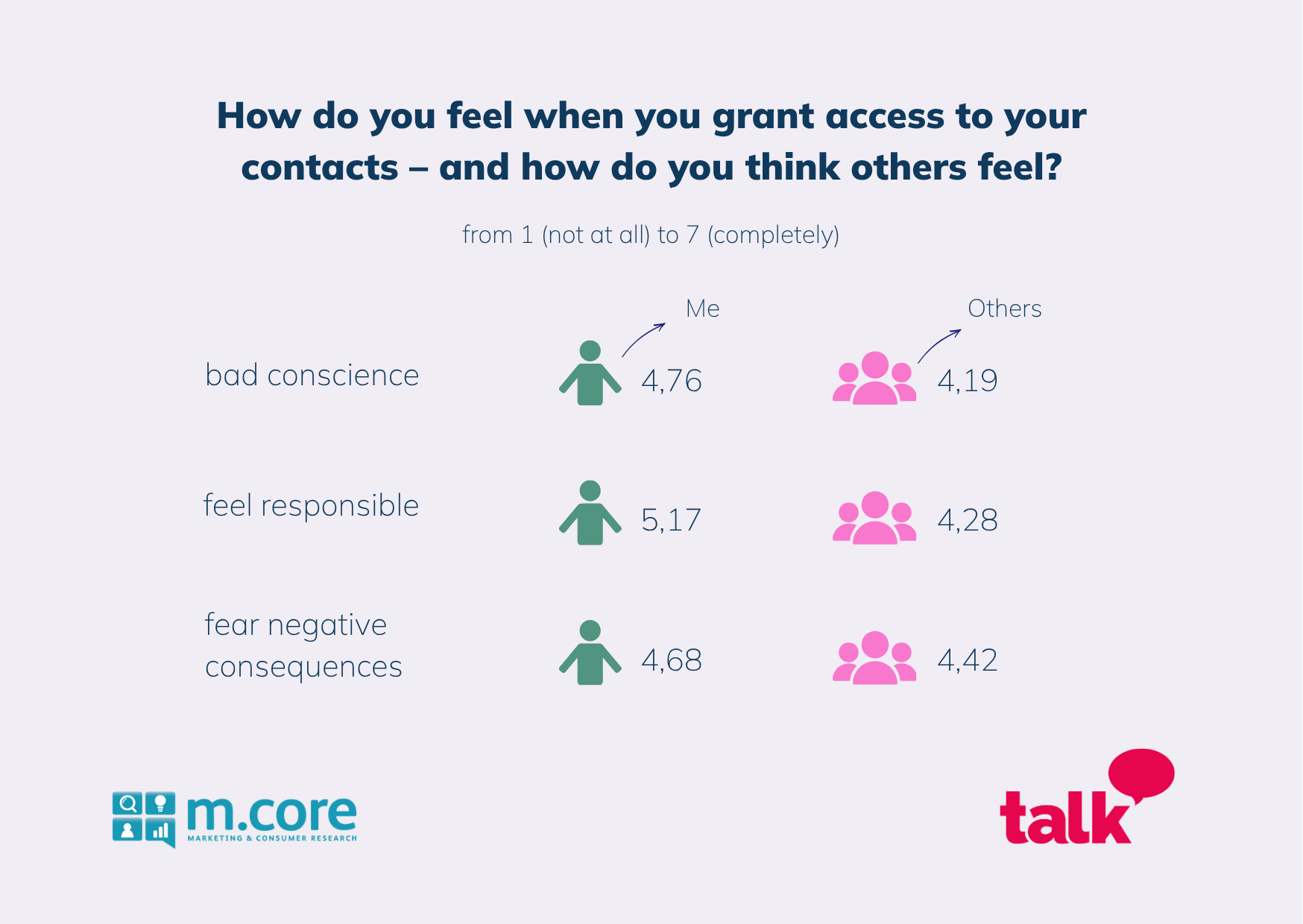
Participants were asked how they would feel after granting an app access to their contacts, rating three dimensions on a scale from 1 (not at all) to 7 (completely): whether they have a bad conscience, whether they feel responsible, and whether they fear negative consequences. They were then asked how they believe others of the same age and gender would feel.
Across all three dimensions, respondents rated themselves more strongly than they rated others. They reported a worse conscience (4.76 vs. 4.19 for others), a greater sense of responsibility (5.17 vs. 4.28), and slightly more fear of negative consequences (4.68 vs. 4.42).
These differences are statistically significant: participants believe they have a worse conscience than others (t(306) = 5.624, p < .001), feel more responsible (t(306) = 9.027, p < .001), and assume they fear negative consequences more than people of the same age and gender (t(306) = 2.480, p = .014).
Age again shapes these feelings. The older the respondents, the more pronounced their bad conscience (r = .288, p < .001), the stronger their sense of responsibility (r = .330, p < .001), and the greater their fear of negative consequences (r = .173, p = .002).
A closer look at gender reveals some clear differences. Women tended to report a worse conscience than men (M = 4.94 vs. M = 4.56, t(305) = -1.724, p = .086) and felt significantly more fear of negative consequences (M = 4.97 vs. M = 4.36, t(305) = -2.852, p = .005). In their sense of responsibility, however, women and men did not differ (M = 5.26 vs. M = 5.07, t(305) = -.993, p = .322).
The results of the Im Fokus survey show that the decision to share personal data with apps is a finely balanced one – roughly half of respondents would grant access to their contacts, while the other half would not. At the same time, people are well aware of the potential downsides, naming spam, the passing on of data, and data theft as their main concerns.
A consistent pattern runs through the findings: respondents attribute a stronger conscience, a greater sense of responsibility, and more fear of negative consequences to themselves than to others. Older participants and women, in particular, show a heightened awareness of the responsibility that comes with sharing other people’s data.
You can find the full report (in German) here!
published: 11.05.2026








You are currently viewing a placeholder content from Turnstile. To access the actual content, click the button below. Please note that doing so will share data with third-party providers.
More Information


